


home 1
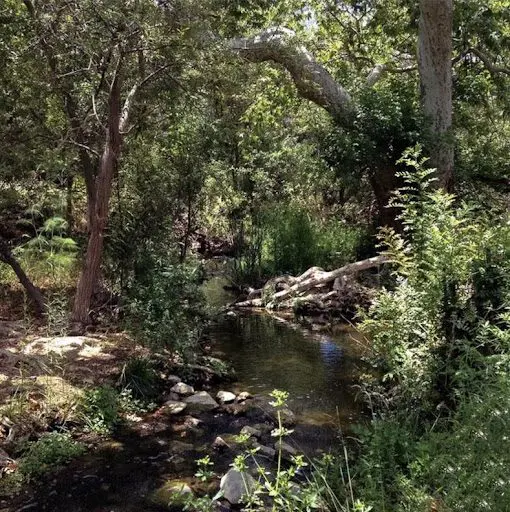
Few people know that in the middle of the San Fernando Valley there’s 2½ miles of the Los Angeles River in a largely natural state, surrounded by 2,000 acres of wildlife reserves, recreation areas and a major water reclamation plant. Left undeveloped following the Los Angeles Flood of 1938 when the Sepulveda Dam was built and the river downstream was confined to a concrete channel; it’s roughly three times the size of New York's Central Park.

Today, there are still areas the Sepulveda Basin where it’s not difficult to imagine what it was like before European settlement. A paradise for its inhabitants; rich in deer, rabbits, trout and a wide variety of flora essential for everyday life, including an abundance of oak trees and acorns.
Our mission is to use the many qualities of this unpolished jewel to create community facilities to enhance the lives of neighbors and visitors; and a studies center for middle & high school students to inspire them to become leaders in creating a sustainable future for themselves; and the wider Los Angeles community.
Utilizing the entire 2,000 acres as an outdoor classroom to nurture new generations of community leaders through a wide range of study opportunities.

Native Plants & Food Systems
- Native plant nursery & foraging garden with Indigenous plant expert Julia Samaniego.
- Culinary laboratory & taste of place restaurant with Indigenous chef Dr Claudia Serrato.

Watershed & Habitat restoration
- 2½ miles of the Los Angeles River & Bull Creek.
- Maintaining hundreds of acres of trails and living outdoor classrooms.

Water & Climate resillence
- State-of-the-art groundwater replenishment for a drought resilient Los Angeles at the Tillman Reclamation Plant.

Indigenous history & knowledge
- Exploring a wilderness of great beauty & bounty and understanding life in pre-colonial times.
- Cultural interpretive center with model Tataviam & Tongva village.

Environmental Design
- Architecture, landscape design & systems planning as sustainable community design solutions.

Avian migration & ecology
- Study of the area’s native avian life, including endangered species—on location and in the interpretive center.
- Field studies in one of America’s most important migration corridors.
“[The Place of the Oaks] will further support Los Angeles Unified’s efforts by providing the opportunity for students to apply the science and engineering practices they learn in their science classroom in a local environmental context.” — Superintendent Alberto Carvalho, Los Angeles Unified School District
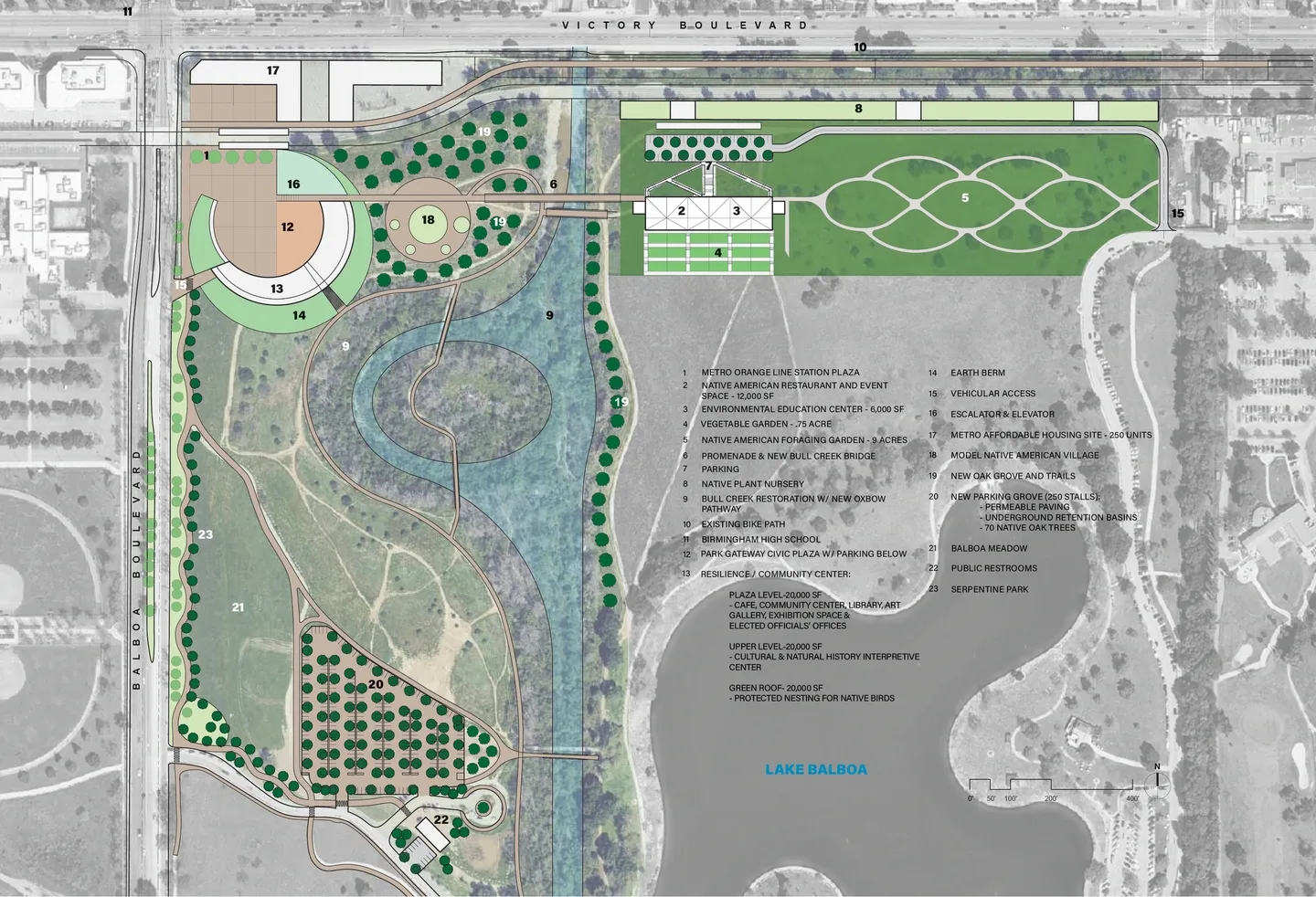
A gateway to the rich natural resources of the Sepulveda Basin with exciting new community facilities.
Expansive circular gateway plaza for performances, community activities and connecting with neighbors.
Crescent shaped community/resilience center with a Native American & natural history interpretive center, art gallery, work and performance spaces.
Café that also sells fresh produce from the kitchen garden and take out meals from the Native American restaurant; and a weekend farmers’ market.
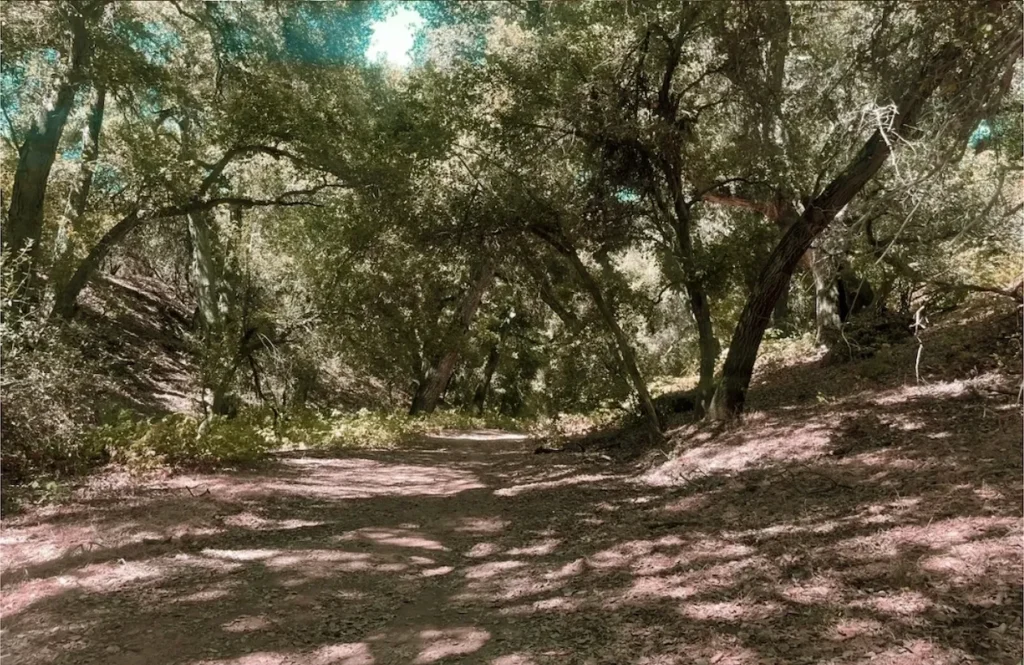
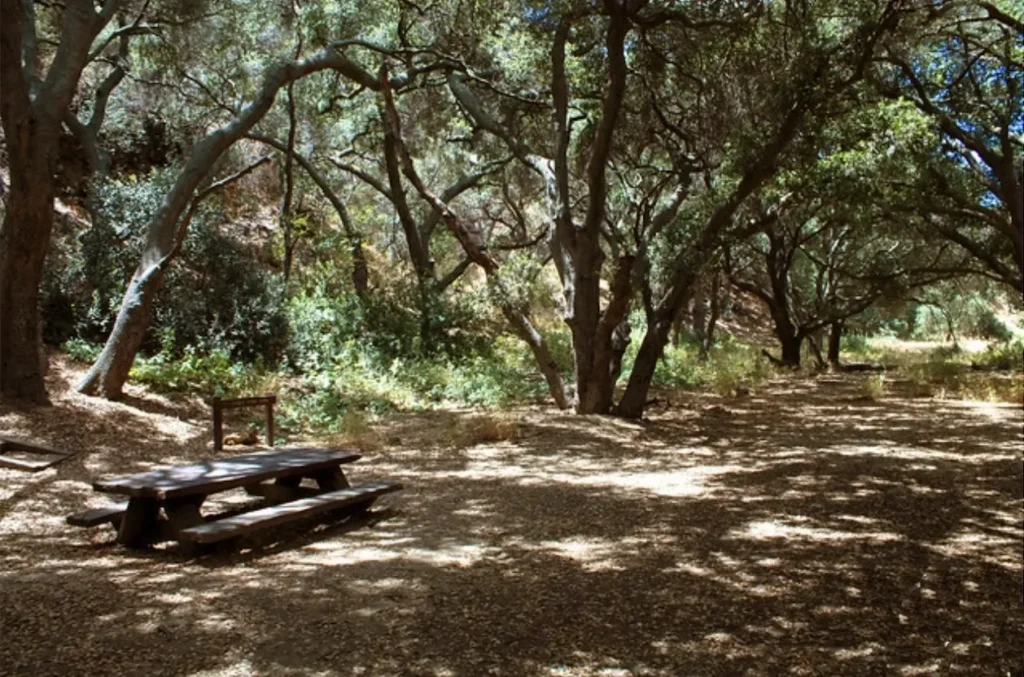
Oak groves to provide shade to an underserved community during heat emergencies, and a place to relax in nature all year round.
Situated immediately adjacent to the G Line Balboa Station and a community of 74% people of color, 34% living below the poverty line and only 16% shade canopy cover.
Indigenous peoples were dispossessed of this land more than once—by their enslavement in the Spanish missions and by the theft of a 4,400 acre land grant after secularization. The FALA team includes members of the Tribes whose ancestors thrived in what we know today as Los Angeles County:
Alan Salazar
Author, story teller, Fernandeño Tataviam and Chumash Tribal Elder.
Julia Samaniego
Co-nursery manager, Annenberg Wildlife Crossing and Fernandeño Tataviam Tribal Member.
Mona Morales Recalde
Gabrieleno Tongva Tribal Member, Member of the LA City/County Native American Indian Commission.
Samantha MJ Yang
Gabrieleno Tongva Tribal Council Member and ecologist, Member of the NHM Commons Native American Advisory Council.
“I didn’t know this land had this history. Now I want to be part of restoring it.” — Liz Garcia, Masters Diploma in Urban Planning, Cal Poly Pomona
Civic gathering spaces underpin the social, cultural and political life of any city. In Los Angeles, sprawling and automobile-dependent, they are largely absent, replaced in some communities by shopping malls. The same urban sprawl that separates us socially and politically also generates an enormous carbon footprint—a primary culprit responsible for our current global environmental crisis.
Our vision is for Los Angeles to be a global model for equity and sustainability, culturally rich and environmentally resilient, with accessible civic spaces to bring our diverse communities together; where all citizens have equal voice and political representation; where social justice is woven into the fabric of the community; and where the enormous creativity of our citizens is on display and tapped to solve our most pressing and existential problems.
Place of the Oaks is a template for our vision. The name is also the English translation of Siutcanga—a pre-colonial Native American village which, with the entire Sepulveda Basin, was part of the 4,400 acre land grant referenced earlier.
At some point in the future, we plan to change the name of our project to Siutcanga: Place of the Oaks. We believe it perfectly represents a group of inter-connected and integrated elements that serve each other—representing a balanced way of living in harmony with each other and with nature.